
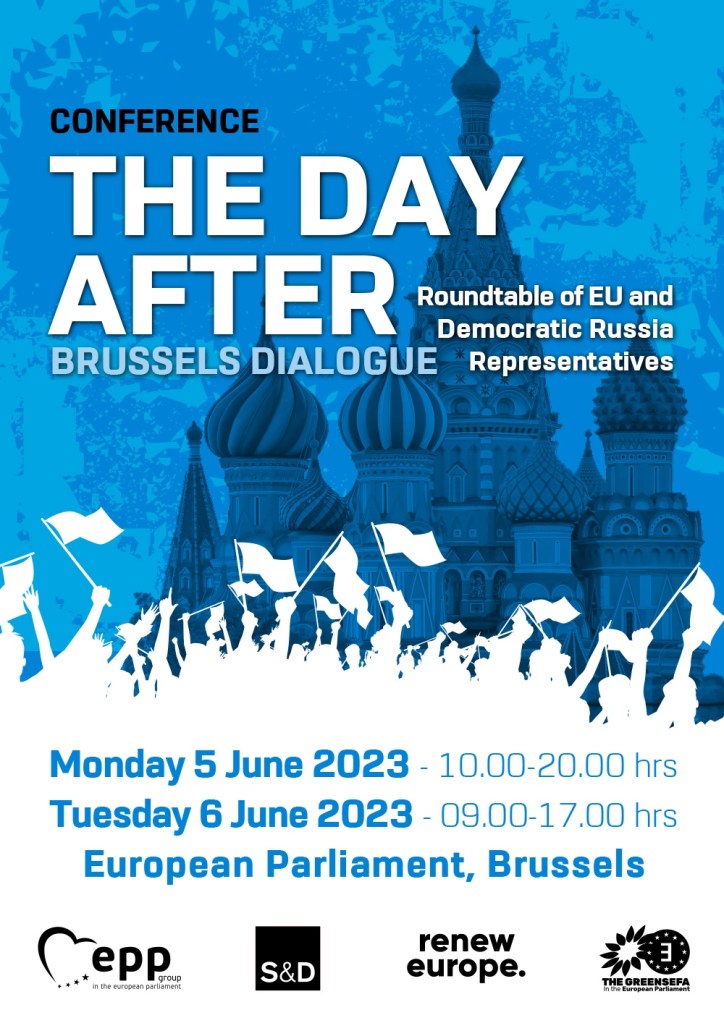
On June 5-6, 2023, the European Parliament will host ‘The Day After’ European roundtable conference on the future of democracy in Russia, convened in the format of the Brussels Dialogue.
More than 250 participants from Russian democratic forces, leading civil society organisations, and EU institutions will attend the conference. The roundtable will serve as a public hearing for the European Parliament’s recommendations to support the democratic transition in Russia.
The conference will discuss the strategy to provide this support. It will explore how to defeat Putinism, achieve victory for democracy, and put an end to the Kremlin’s aggressive war against Ukraine. The role of Russia’s democratic civil society and the EU’s support will also be addressed.
Is there a future for Russians? What is it like, and how can it be earned? What could be the idea of a free Russia? What lessons can be learned from its history? How can the geopolitical alliances of the West ensure the collapse of the evil empire is irreversible?
One of the key questions is whether there can be a unified strategy for civil society to defeat the Putin regime. Can it make an impact as a collective? How can solidarity, political activism, and international influence be achieved in the fight against Putinism and its war against humanity?
There will be many questions raised and answers given during the conference’s two days and ten panels. However, that alone is not enough.
Ukraine knows the formula for victory, and the West has come to its aid. Has the time now come to help the democrats in Russia? Is there significant political resistance and mobilization of civil society? If so, on which fronts should the struggle be waged?
At least three fronts can be identified.
The first front: defending Ukraine.
It is clear that the future of Russia is being decided in Ukraine. The focus now is on defending Ukraine through arms supplies, sanctions, international coalition, and the establishment of a tribunal against Putin’s crimes of aggression.
Democracy in Russia is not possible without the European perspective for Ukraine. What actions are necessary to help Ukraine’s accession to the EU, and what cooperation is needed to utilise Russian frozen assets and reparations for the recovery and reconstruction of Ukraine?
The second front is about defending civil society and the Russian people against the Kremlin regime, which aims to destroy any prospects for the future and desires a Russian colony for its people.
Access to free media content is crucial. Investigative journalism, internet technologies such as artificial intelligence, are effective tools to counter the Kremlin’s propaganda.
Ultimately, it is important to have a vision of a free and democratic Russia and to develop a strategy for further relations between such a Russia and the EU. This requires diplomacy and support programs necessary to stay on the path of European civilisation.
The third front is about working with international institutions.
Democratic forces need an effective international platform for relations with the EU in support of democracy. A strategy for the European Eastern Partnership for democracy in the region, including Russia and Kazakhstan, is needed. Working with countries and capitals of the EU is important. Regularity of relations through the office or embassy of democratic forces in Brussels, as well as a close relationship with democratic Belarus and Ukraine, must be established.
Democratic forces need to find their place in EU politics. This place in the EU is still open. The democrats from Russia must seek power and recognition because democracy is a struggle for their existence, their future, and freedom. It is a struggle for their homeland. A struggle on all fronts.
 Alter Publicus